Friday, June 23, 2017


Sunday, June 11, 2017
Rational oral primary antibiotic selection in outpatient pediatric patients
2.what's the spectrum of oral antibiotics
3.what are the different pediatric outpatient issues
4.how to differentiate need for antibiotic in pediatric outpatient issues
5.what are the subjective and objective marker s
6.what are the possibilities for IV antibiotics
7.when do we needs to change or descalate
8.why complete dose and course and how to ensure same
9. How to guess the organism
10. How to judge the severity
11.RS GI SKiN CVS UtI examples
Continued...
posted from Bloggeroid
Saturday, May 23, 2015
Hypovolemia in children
Its the common pathology that is coexistent with most deaths all over the world. Hypovolemia that is missed or undertreated gets into vicious cycle of reduced urine output and renal hypofunction that can never be improved without adding fluids.
Remember high fluids intake can eb washed of with diuretics but low fluids with vicious inotropic support can be killing.
Also hyperkalemia ie common coexistent terminal electrolyte issue around death. Potassium supplements especially fruits often are needed for only dehydrated kids with low potassium.. but uts always better we treat them with hospital support than with potassium.
But fruit juices especially coconut juices can surely do harm for patients especially with kidney related issues who are at risk of developing hype kalemia.
Moral is... reserve fruits and juices for healed patients and not the sick ones.
Www.pediatricianonline.in
Thursday, May 21, 2015
ERG or VEP?
Often blindness is associated in neuro metabolic diseases apart from hyperbarix oxygen damage in new borns to ocular infection s.
We follow retina assessment protocol for suspected retinal detachment in nicu or ventilator graduates..
For optic atrophy no obvious tests but a repeat check after three months following a heavy dose steroids helps doc call it irreversible.
In extensive retinal disease both ERG that is electroretinogram and VEP are likely to be abnormal.
In retinitis pigmentosa as in storage diseases ERG may be affected though VEP may be preserved.
Vice versa in macular degeneration VEP is affected and ERG May be intact.
For diseases like galactosemia and wilsons monitoring lens ofr cataract is important so is in steroid toxicity.
Saturday, March 08, 2014
marcus gun jaw winking synkinesis
http://drpeds.blogspot.comhttp://funnytrivias.blogspot.comDr Kondekar Santosh venketraman is a MD pediatrician at seth GS medical college and KEM HOSPITAL MUMBAI INDIA
Friday, March 07, 2014

Tuesday, June 05, 2012
secrets of managing diaper dermatitis in children.. for doctors
secrets of DD are out : let me end this discushion : remember these basic points.
unless we know the cause treatment is useless.
There are 4 main types of rashes that occur in this area.
fungal,
cellulitis,
ammoniacal dermatitis and
allergic or contact dermatitis.
Barring zinc deficiency, PEM etc are mainly for chronic ones.
now there is one single point to diagnose each of them.
fungal has satellite lesion == look for them,
cellulitis is tender to touch= feel for it,
ammoniacal has must involvement of tip of penis or clitoris and has ammo smell often related to urealytic organisms,
contact can be elicited by repeated use at friction points more often than in center.
treatment is accordingly,
fungal... prefer antifungal cream prefer mico for dry lesions, antifungal powder for wet lesions .
bacterial == local and systemic antibacterials are must,
ammoniacal needs soothing emolients with zinc and some antibiotic like nitrofurantoin,
contact responds to emolients and at times steroids.
common treatment for all is
avoid diapers however tempting it may be.
keep the area open till healing,
donot rub but mop after a motion.
avoid moisture as much and as often,
fan the area..
remember calamine is fooling and use only for very mild.. to be or not to be cases. No references ...
Sunday, July 17, 2011
childhood asthma in india need for modifying GINA guidelines for INDIA
http://drpeds.blogspot.com/ http://funnytrivias.blogspot.com/ Dr Kondekar Santosh venketraman is a MD pediatrician at seth GS medical college and KEM HOSPITAL MUMBAI INDIA
Sunday, February 20, 2011
national treatment guidelines for malaria
Thursday, November 25, 2010
ring enhancing granulomas, vanishing CT scan lesions

tumors,oncogenes,syndromes
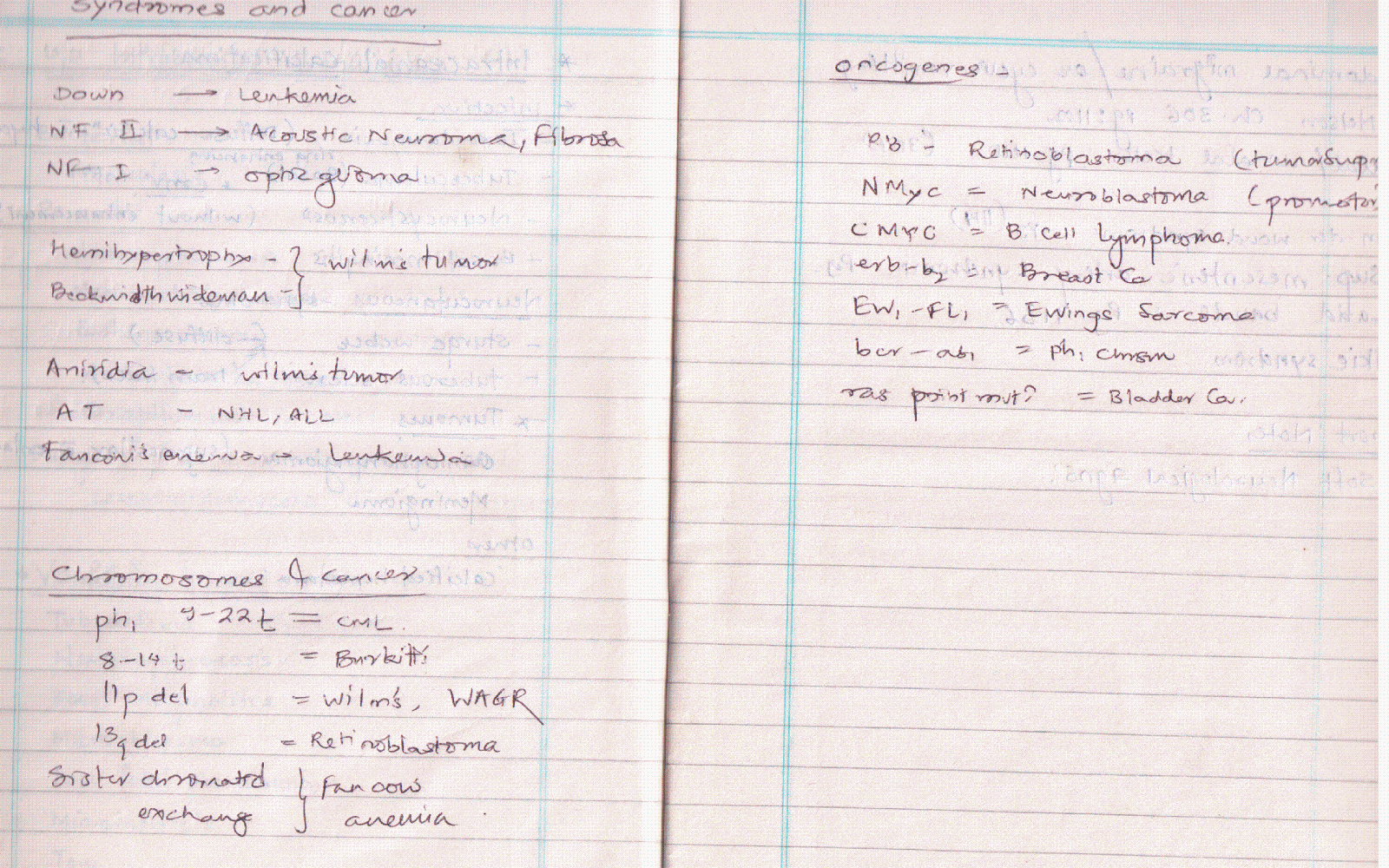
floppy infant syndrome

Monday, October 11, 2010
failure to thrive approach

Thursday, June 03, 2010
FW: {Pediatric Doctors} Few formulas which might help doctors working in NICU
Its a common problem in NICU that due to hypoglycemia or hyperglycemia, we have to either discard the TPN or change the IVF mix. Its a huge loss to the hospitals. I made few formulas to change the dextrosity which I want to share with all of you.
1)Potdar's Neonatal formula to decrease the dextrosity of solution
Present volume-- PV ml
Present dextrosity – PD%
Desired dextrosity – DD%
ml of sterile water required— Y ml
Formula :-
(PV x PD) +(Y x 0) = (PV+Y) x DD
Y=PV(DD-PD)/DD ml of sterile water needed
Exp—
Weight of infant 1 kg
Total fluid required @100 ml/kg/day = 100(PV)
Present Volume—100 ml
Present dextrosity --- 20
Desired dextrosity—18
Ml of sterile water required—
= (100 x 20) + 0 = (100+Y) x 18
= 2000 = 1800 + 20 Y
= 20Y = 2000-1800
= 20 Y = 200
Y = 200/20
Y=10 ml of sterile water
OR
Y= PV(DD-PD)/DD
Y= 200/20
= 10 ml of water
This small amount of water may dilute the electrolytes. For this, either you can add electrolyte in same proportion or may increase the fluid rate to give this extra amount in set time if clinically
feasible.
2)Potdar's Neonatal formula to increase the dextrosity
Present volume -- PV ml
Present dextrosity – PD%
Desired dextrosity – DD %
ml of 50% dextrose required— Y ml
Formula :-
(PV x PD) +(Y x 50) = (PV+Y) x DD
Y= PV(DD-PD)/50-DD ml of 50% dextrose required
Exp—
Weight of neonate-- 1 kg
Total fluid required @ 100 ml/kg/day—100 ml (PV)
Present dextrosity --- 18%
Desired dextrosity—20%
Ml of 50 % dextrose required—
= (100 x 18)+ 50 Y = (100+Y) x 20
= 1800 + 50 Y = 2000 + 20 Y
= 50Y- 20Y = 2000-1800
= 30 Y = 200
Y = 200/30
Y=6.7 ml of 50 % dextrose.
OR
Y = PV(DD-PD)/50-DD
Y = 100(20-18)/50-20
Y = 200/30
=6.7 ml of 50 % dextrose
This small amount of dextrose may dilute the electrolytes. For this, either you can add electrolyte in same proportion or may increase the fluid rate to give this extra amount in set time if clinically feasible.
3)Making IVF mix with D10% and D 50% (or any two solutions of different dextrosity)
In many neonatal nursery IVF mix is made by adding sterile water and D 50%. Which is more costlier. We can make IVF mix by D10 and D50%.
Formula--
General formula for any two solutions with different dextrosity=
Total volume required= TV
ml of solution containing higher dextrosity(HD%)= X ml
ml of solution containing lower dextrosity(LD%)= TV- X ml
Desired dextrosity= DD
X ml = TV(DD-LD)/(HD-LD) ml of HD in TV
ml of LD in TV = TV- X ml
exp-
Total volume required is 100 ml
Desired dextrosity is 16% and we have D10 and D50%
HD=50%
LD= 10%
ml of D 50 (X ml) = 100(DD-10)/(50-10)
ml of D 50% ( X ml) =100(16-10)/40 ml
= 600/40 ml
= 15 ml
ml of D10%= 100-15=85 ml
Manage your finance and manage money through MSN Money Special Drag n' drop
Sunday, February 28, 2010
Yale Observation Scale
Indications
1.Assessment of febrile child ages 3-36 months
2.Predicts serious infection (Occult Bacteremia)
3.Quantifies "Toxic Appearance" in children
Interpretation
1.Score = 10 : Incidence serious illness: 2.7%
2. Score = 11-15 Incidence serious illness: 26%
3. Score >16 Incidence serious illness: 92.3%
Scoring
Quality of Cry
Strong or No cry: 1
Whimper or Sob: 3
Weak cry, Moan, or high pitched cry: 5
Reaction to parents
Brief Cry or Content: 1
Cries off and on: 3
Persistent cry: 5
State variation
Awakens quickly: 1
Difficult to awaken: 3
No arousal or falls asleep: 5
Color
Pink: 1
Acrocyanosis: 3
Pale, Cyanotic, or Mottled: 5
Hydration
Eyes, skin, and mucus membranes moist: 1
Mouth slightly dry: 3
Mucus Membranes dry, eyes sunken: 5
Social Response
Alert or Smiles: 1
Alert or brief smile: 3
No smile, anxious, or dull: 5
------------------------------------------------------------------------------------
www.doctorchild.com
Dr Kondekar Santosh venketraman is a MD pediatrician at seth GS medical college and
KEM HOSPITAL MUMBAI INDIA
Saturday, November 29, 2008
Pharyngitis
"Viruses are isolated in approximately 40% of cases and include rhinovirus, adenovirus, parainfluenza virus, coxsackievirus, coronavirus, echovirus, herpes simplex virus, Epstein-Barr virus (mononucleosis), and cytomegalovirus. Primary bacterial pathogens that account for approximately 30% of cases of pharyngitis in children include GABHS (common), group C streptococci (uncommon), group G streptococci (uncommon), Neisseria gonorrhoeae (uncommon), Corynebacterium diphtheriae (rare), and Corynebacterium hemolyticum (extremely rare)."(ref:http://www.emedicine.com/EMERG/topic395.htm)
Where as its easy to suspect a viral aetiology if some of the symptoms and or signs are present; viz: typical prodrome, cold, conjuctivitis, rhinorhea, wheezing etc; its absence doesnt truly mean its bacterial in origin.
Bacterial sorethroat similarly has some of the characteristic findings like white patch/ granular inflammation /microabscess / associated acute lymphnode enlargement / lymph node tenderness, sinus tenderness, scarlet rash / membrane etc. But absence of these findings may help one suspect strongly a nonbacterial infection.True; nothing is certain.
The real reason to treat pharyngitis emperically and urgently; is the risk of its sequalae like glomerulonephritis, rheumatic fever and kawasaki disease.These risks are always there with even asymptomatic streptococcal pharyngitis; but documentation of streptococcal throat culture negative after therapy gives some clinical satisfaction in curtailing at least some of GABHS disease.
I prefer to stick only to conservative therapy in throat infections, mainly because most of throat and related infections in children below 2 years are viral origin and in children above 2 years, bacterial infections usually localise and also give enough time to observe/evaluatethe course of disease.
The therapy that works best is soothing normal saline nebulisation for throat relief, added to paracetamol for relief from fever and malaise for 2-3 days; keeping a close watch on development of any diagnostic signs for viral /bacterial aetiology, and if required, antibiotics; after a CBC / ASLO / culture as per the regional recommendations.
====================================
Dr Kondekar Santosh venketraman is a MD pediatrician at seth GS medical college and
KEM HOSPITAL MUMBAI INDIA
Tuesday, July 10, 2007
Mental retardation a video review
view the video full screen
Dr Kondekar Santosh venketraman is a MD pediatrician at seth GS medical college and
KEM HOSPITAL MUMBAI INDIA
Friday, May 18, 2007
if you are looking for a page and it is not seen here, please check archives or site search. thank you.
http://drpeds.blogspot.com
http://funnytrivias.blogspot.com
Dr Kondekar Santosh venketraman is a MD pediatrician at seth GS medical college and
KEM HOSPITAL MUMBAI INDIA
CCF and shock in children
How is it possible?
Shock is a situation caused by disparity between fluid volume and capillary bed manifesting as poor pulse and blood pressure.
CCF or congestive cardiac failure is a condition caused due to increased preload following venous overload or cardiac hypo function.
In late stages both these cases can overlap, as shock can cause cardiac dysfunction and cardiac dysfunction due to CCF can lead to shock.
And thus most patients coming in late stages to emergency room are falsly interpreted as shock or CCF especially when the facility for JVP CVP BP measurements is not available or faulty. ( yes its likely- as BP measurement varies with age size of cuff and the person who is taking BP and there are no clear cut levels in any area or age for lowest normal BP. Also CVP may be difficult due to venous access in shock. The CVP reading change with movements , intervention and position of CVP catheter tip which may require an X-ray to confirm.)
In addition the confusion arises due to possibility of presence of congenital heart disease or carditis in children. if the child had a chronic heart disease, its more likely that the decision fo CCF si very often made, as the baseline hepatomegaly and cardiomegaly as a part of chronic heart failure is wrongly interpreted as acute CCF.
Similarly, as in acute carditis or sepsis, raised JVP the only important clinical sign apart from cardiomegaly, is difficult to examine and interpret especially in infants, the failure of heart is interpreted as shock.
As both these conditions present with common findings at some stage
: Tachycardia, poor or weak pulse and low blood pressure and desaturation.
They are easily confused unless an expert decides from various other clinical markers.
why do we need to discriminate the two: CCF and shock?
Because, the treatment differs.
for CCF the main therapy is volume reduction diuresis and judicious blood transfusion and digoxin. And rarely inotropes.
And in shock its fluid pushes and inotropes.
A wrong judgment will take you in wrong direction with vicious events.
Some basic understandings will help not making this mistake:
==================================================================
read http://www.nhlbi.nih.gov/health/dci/Diseases/hyp/hyp_whatis.html
read aug 2008 IJP symposium septic shock Indian journal of pediatrics
http://drpeds.blogspot.com/ http://funnytrivias.blogspot.com/ Dr Kondekar Santosh venketraman is a MD pediatrician at seth GS medical college and KEM HOSPITAL MUMBAI INDIA
http://drpeds.blogspot.com
http://funnytrivias.blogspot.com
Dr Kondekar Santosh venketraman is a MD pediatrician at seth GS medical college and
KEM HOSPITAL MUMBAI INDIA
Friday, April 13, 2007
experience of tetanus cases from mumbai
Even though least cases are seen these days due to effective maternal and childhood immunisation programs; in many areas of developing countries like India, do have significant number of patients presenting as tetanus to tertiary care centers. And few of them have mortalities too.
The once famous Jog and patel clinical score criteria based on fever, tachycardia, number and areas of spasm / trismus; and autonomic disturbances is less often used by many pediatricians; and those who use modify as per their covenience, as the dosages proposed according to clinical score; can be as high as 60 to 80 mg/kg of oral diazepam which is usually not supported by standard textbooks. And also the clinical scores do change very often with or without treatment, a titration of oral dose accordingly doesnt appear a logical solution; as oral absorption of diazepam is erratic. ref 1 2 3
What is more important in management of tetanus is correct diagnosis. A lot many cases are wrongly diagnosed as tetanus; as many people are not awrae of what is trismus and how to check for it. Trismus or lock jaw is a clinical condition that is considered very diagnostic of tetanus; ( and as investigations are often useless in diagnosing tetanus, trismus serves as the sole gold standard diagnostic criteria for tetanus); it is characterised by forecful spasm of jaw muscles with inability to open mouth even under mild pressure; and it is demosntrated in best way by introducing a tongue depressor in mouth; rather attempting to do so; will fail to open mouth. Its very prudent to divert child's attention so that voluntary spasms dont coexist.
Tetanus can be diagnosed in absense of trismus from spasms, rigidity of neck trunk limbs and abdomen; with normal sensorium in a child witha focus of infection and / or history of nonimmunisation.
A wrong diagnosis of trismus will take the child for wrong line of management and vicious cycles of diazepam therapy; and lrolonged hospital stay with addition of multiple medicines; and avoiding all further tests; because once a doc makes diagnosis fo tetanus; usually others dont question it.
How does one make a wrong diagnosis of trismus?
1. false interpretation of voluntary spasm
2. examination by inexeperienced doctor
3. patient may have a seizure and may be interpreted wrongly
4. it can be associated with contradictory neurological signs
5. altered sensorium almost rules out tetanus, unless its following severe hypoxia; which is very rare.
6.if the patient presents to hospital after receiving diazepam and one has no clue to check for trismus
So please reecheck the trismus again, preferably by a senior too; and look for supprtive signs / spasms or contradicting neurological signs.
Another important thing after diagnosis of tetanus, is curtailing a spasm at the earliest. if we donot curtails spasms, they add on to precipitate sever bronchospasms and death.
a spasm should be preferably curtailed only with parenteral diazepam; preferably IV ( diluted with blood) or Intramuscular preferably in deltoid; or per rectal (when IV access is not possible); and never oral.
dose of parenteral or oral diazepam given in most books in 0.2 to 1 mg/kg / dose; which in cases of tetanus appears to be refractory. midazolam doesnt prove promising; and has no benefit in tetanus cases.
Remember diazepam almost never causes of respiratory depression even in higher doses (unless added with another drug like phenobarbitone). Almost all cases of diazepam poisoning recover satisfactorily in a week. ALso, the common morbidity follwoing diazepams is mostly due to its cumulative sedation and vasodilation causing intracranial bleeds.
In tetanus, one may need doses as high as 1-5 mg/kg bolus or tetanus preferably in divisions every 10 minutes (for those who are scared of large dose). to curtail an acute spasms. A spasm can also be controlled by giving muscle relaxants or by causing paralysis; but that make sthe child ventilator dependant.. ( and many are scared of intubations in tetanus cases and go for tracheostomies adding another morbidity.
I had used upto 10mg/kg/dose boluses without causing any problems for curtailing the spasms. Only svere bronchospasms may require high dose diazepam.
Other ways, are to start a low dose diazepam infusions after a bolus diazepam; the infusion are usually 0.2mg/kg/hr for no more than 2 days. dose can be increased gradually; till spasm, but once spasm is controlled for an hour, please taper the diazepam drip rate hourly to avoids intracranial bleeds. switch over earliest to oral or rectal diazepam therapy.
oral diazepam therapies are started at doses of 40, 60 and 80 mg/kg/day in mild , moderate amd sever tetanus respectively. With time, the doses have come down to 20. 40, 60 respectively.
The absorption is errartic with oral. addition of antacids hampers absorption and vomitting and gastritis are frequent complications but are easily treatable.
In the past various antibiotics have ben used for various reasons, but as the clostridia are anaerobes, metronidazole as a single drug chemotherapy usuallky suffices unless another bacerial contamination or pus is documented.
Other CNS dperessants like phenobarbitone, chlorpromazine and chlorzoxazone have been trie in past with erratic regimens without any evidence based benefits. Baclofen is a safer switch over drug due to safety of relaxing mainly skeletal muscles. its action usually is seen by 3rd day, dose range form 0.2 to 1 mg/kg/dose 3-4 times a day.
Tracheostomies especially emergency ones have been associated with significant morbidities.
usually the spasms get controlled in 3-5 days, diazepam can be started tapering once 3 days spasm and rigidity free are observed, but needs to be titrated judiciously. Sometimes spasms may recur again to increase the dose of diazepam. ALl can settle in 2- 4 weeks.
Not to forget, the most important therapy in tetanus management is Tetanus immunogolbulin in high dose to titrate with tetanospasmin; usually 500IU in newborns, 1500IU in infants and 2000 to 3000 IU in children to adults; alongwith primary tetanus immunisation fo child and family.
http://www.pedsccm.org/RARE/Tetanus.html
Lorazepam may be preferable . Limited experience with propofol ,Dantrolene Baclofen Further clinical studies needed. Prompt recognition and treatment of autonomic dysfunction are important in reducing the mortality in this disease.
Author Dr Kondekar Santosh is a pediatrician at Seth G S medical college at KEM Hospital Mumbai india. All of the above opinions are his personel opinions out of personel experience, for more details write to santoshkondekar@kem.edu .